Hunyuan 3D-2.1: Democratizing High-Fidelity 3D Creation
Hunyuan 3D-2.1 delivers cinema-grade 3D models with physics-driven textures in minutes. Built by Tencent Hunyuan3D, this open-source powerhouse lets studios, indies, and hobbyists fine-tune, extend, and ship production-ready assets on everyday hardware. Explore Hunyuan3D-2.1 today and experience why Hunyuan 3D-2.1 is rewriting the rules of 3D art.


Generated Result

How to Create with Hunyuan3D?
Creating textured 3D models with Hunyuan 3D-2.1 is simple and efficient. Follow these steps to unlock the full potential of Tencent Hunyuan3D v2.1.
- Step 1: Access the Hunyuan 3D-2.1 repositories on Hugging Face or GitHub and install dependencies exactly as documented by Tencent Hunyuan3D.
- Step 2: Upload an image or prompt into the Hunyuan 3D-2.1 interface to launch the diffusion-based shape generator and PBR texture synthesizer.
- Step 3: Refine your mesh inside Hunyuan3D Studio, tweak material parameters, and export your Hunyuan3D-2.1 asset as OBJ, FBX, or GLB for immediate use.
Features of Hunyuan3D-2.1
End-to-End Open-Source Stack
Hunyuan 3D-2.1 ships full model weights, data pipelines, and training code, letting you audit, retrain, or extend Tencent Hunyuan3D with zero vendor lock-in.

Consumer-GPU Optimization
Designed for 12 GB cards, Hunyuan 3D-2.1 delivers triple-A meshes without data-center costs—perfect for home rigs, indie studios, and rapid prototyping.

Physically-Based Rendering Textures
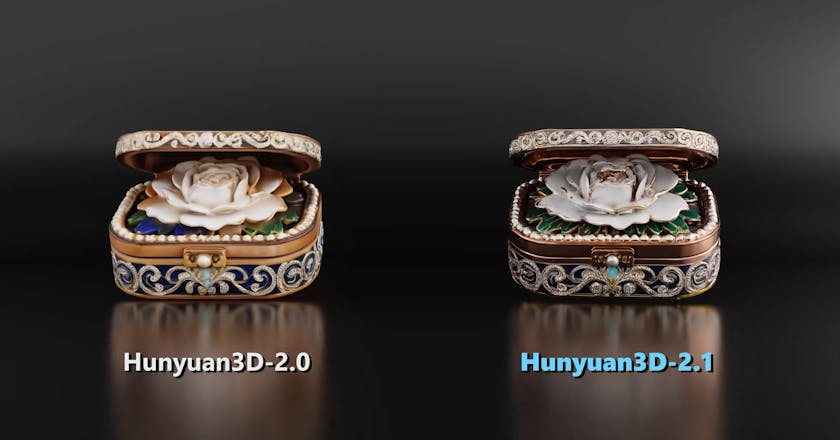
The PBR engine in Hunyuan 3D-2.1 simulates metallic reflections, roughness, and subsurface scattering for lifelike results that outshine earlier Hunyuan3D v2.0 builds.

Lightning-Fast Diffusion Pipeline
Thanks to flow-matching DiT blocks, Hunyuan 3D-2.1 slashes generation time while boosting ULIP-T and Uni3D-I accuracy scores, elevating Tencent Hunyuan3D ahead of rivals.


Frequently Asked Questions about Hunyuan3D
What makes Hunyuan 3D-2.1 different from other 3D generators?
Hunyuan 3D-2.1 combines full open-source transparency with a physics-driven PBR pipeline, delivering higher realism than closed competitors while letting developers customize every layer. This flexibility sets Tencent Hunyuan3D apart.
Is Hunyuan 3D-2.1 really free for commercial use?
Yes. Tencent Hunyuan3D licenses Hunyuan3D-2.1 under permissive terms that allow commercial distribution of assets. Just keep the required attribution line: “Created with Hunyuan 3D-2.1.”
Which GPUs can run Hunyuan3D v2.1 efficiently?
An NVIDIA RTX 3080 with 12 GB VRAM handles most scenes. For ultra-high-detail jobs, Hunyuan 3D-2.1 scales up to RTX 4090 or multi-GPU servers without code changes.
Can I fine-tune Hunyuan 3D-2.1 on my own dataset?
Absolutely. The released training scripts let you retrain Tencent Hunyuan3D on proprietary images or CAD data, creating domain-specific versions of Hunyuan3D-2.1.
Does Hunyuan 3D-2.1 support multi-view inputs?
Yes. Activate the `max_num_view` flag to feed up to six photos, and Hunyuan3D v2.1 will fuse them into a single high-accuracy mesh with aligned PBR textures.
How realistic are the materials generated by Hunyuan3D-2.1?
The PBR synthesizer in Hunyuan 3D-2.1 models diffuse, metallic, roughness, and normal maps, capturing micro-details like leather grain or brushed aluminum.
Can I use Hunyuan 3D-2.1 assets in game engines?
Yes. Hunyuan3D-2.1 exports standard OBJ/FBX/GLB with embedded PBR maps, making Tencent Hunyuan3D assets drag-and-drop ready for Unity and Unreal.
Is there a web demo for Hunyuan3D-2.1?
Tencent Hunyuan3D hosts a Hugging Face Space where you can test Hunyuan 3D-2.1 in your browser. For heavier jobs, clone the repo locally.
How do I contribute to the Hunyuan3D community?
Fork the Hunyuan 3D-2.1 repo, submit pull requests, or share checkpoints. Tencent Hunyuan3D maintains an active Discord for idea exchange.
Where can I find benchmarks for Hunyuan 3D-2.1?
Official ULIP-T and CLIP-I scores are in the GitHub README. Independent reviewers consistently rank Hunyuan3D v2.1 at the top for geometry accuracy and texture fidelity.